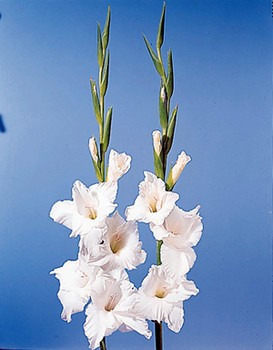
November Birth Month Flower is Chrysanthemum
| Botanical Name : | Chrysanthemum X morifolium (Dendranthema X grandiflorum) | |
| Common Name : | Chrysanthemum, Mum, Florist Mum | |
| Product Use : | Cut Flower | |
| Pronunciation : | kris-AN-the-mim X mor-i-FOL-i-um (den-DRAN-the-ma grand-I-FLOR-um) | |
| Family Roots : | Member of the Asteraceae or Compositae (aster or sunflower) family. Native to China. Common relatives include Cosmos, Dahlia, Calendula, Zinnia, strawflower, lettuce, artichoke and endive. |
|
| Personality : | Composite heads of ray and disk flowers in numerous forms and sizes at ends of branches. Stems are leafy, usually branched or pinched to form one or more flowered stems. Plant is a semi-woody perennial, classed as a dicotyledon, leaves not parallel veined. Flowers are not fragrant in the typical manner but may be aromatic. |
|
| Availability : | Year-round. | |
| Flower Color : | Shades of red, pink, orange, bronze, yellow and white. | |
| Decorative Life : | 7-14 days, some types last longer. | |
| Ethylene Sensitivity : | Low | |
| Ethylene Comments : | Not sensitive at generally encountered ethylene levels in the commercial world. At higher levels, growth can be stunted (internodes shortened) and leaf fall is possible. | |
| Post Harvest Care Opportunities : |
Make sure stems are cut above
any woody portions to ensure good water uptake and do not pound stem
ends, as this does not increase water uptake. Rather, remove bottom
leaves if present, recut stems under water and place into a fresh
flower food solution. Deionized water may reduce vaselife compared to
tap or well water. The sugar in flower food is required for florets to
develop to maturity. Foliage yellowing and wilting can be due to improper storage, growing conditions and/or high levels of sugar in the vase solution. Using commercially sold benzyladenine sprays or uptake solutions can retard leaf yellowing. A more novel approach is to place freshly harvested cut stems into a 3-4% methanol and water solution for 12-24 hours at 70F prior to shipping. Flowers failing to open entirely generally means that they were harvested too immature and/or they were exposed to high temperatures after harvest. |
|
| Storage Specifics : | Storage at 36-38 F (3 days or less) is fine, 32-34 F (if over 3 days). Stems with well-developed buds may be stored for up to 3 weeks. | |
| Preharvest & Harvest Factors: |
Plants grown at high (93%) relative humidity lasted longer after harvest compared to those grown at 81 and 70%. | |
| Tidbits : | From Greek "dendron" (tree)
and "anthemon" (flower). Many flower forms exist-standards have one
flower per stem, spray mums are branched with several flowers per
stem. Some form classes are daisy, spider (Fuji), quill, football,
pompon, cushion, button and spoon. The "X" in the name means that it
is a hybrid between at least two species. The specific epithet name
grandiflorum means large flowers. Mums have been cultivated in China for 2000 years, infusions of the leaves and flowers were used as medicine and fermented into wine. The dew collected from the flowers was said to promote longevity. The mum was introduced to Japan in 400 AD and became the emblem of the imperial family. Name was recently changed back to Chrysanthemum X morifolium. It is a short day plant meaning that it will only flower when the days are short and the night long. That is why it naturally only flowers in the fall. At other times of the year the light/dark periods of the day have to be controlled by growers to promote flowering. Mums reached Europe in the late 18th century, where the Chusan daisy became known as the pompon chrysanthemum because it resembled tassels on French sailors' hats. In Italy, mums are associated only with funerals and death. Some favorite cultivars and their respective flower colors include 'White Diamond' (white), 'Pelee' (orange and yellow) 'Shasta' (white), 'Regal Davis' (purple) and 'Miramar' (yellow). Appearance of pink/red coloration on petals for cultivars not of this color indicates old flowers and/or flowers grown too cold. Material leaking out of carnation stems held in the same container as mums can often reduce the life of the mums. The Compositae or aster family is vast, with over 20,000 species, and is also one of the most developed families. It was named Compositae because the flowers are actually a "composite" of many individual flowers into one head. Hence, when children pull one "petal" off at a time, saying "she/he loves me, loves me not", they are actually removing a complete flower, not just a petal. Today, the flower heads, when dried, are used to flavor soups and stews and as coloring for butter. According to Creasy (1999), fresh petals are edible. Can be used in salads and teas or sprinkled over clear soups. Chrysanthemum is the Birth Month Flower for November: http://www.hoogasian.com/BirthMonthFlowers.html | |